
News
Cooking with Hand-Forged Copper: The Performance of Artisan Cookware

Sep
In a modern kitchen, the choice of cookware directly dictates how energy moves from your cooker to your ingredients. While lightweight metals are often chosen for simple convenience, heavy, hand-hammered copper pans made by traditional Italian smiths introduce an entirely different standard of utility to the home. Copper functions as an active tool that alters how heat behaves, providing a level of temperature control that changes your daily cooking habits and the longevity of your kitchenware.
Our previous journals explored the history of copper across ancient civilisations and its role as a decorative element on open shelving. This article moves past design trends and regional lineages to focus entirely on the physical characteristics of hand-forged copper—exploring how traditional cold-hammering, hand-tinning, and thermal responsiveness change the practical act of cooking.
The Workshop Floor: The Work of the Tanucci Family
To understand why an artisanal copper pan performs with such precision, one must look at the traditional production methods preserved by generations of smiths. In the workshops of the Tanucci family, copper smithing operates on a process of manual shaping that alters the physical properties of the raw metal.

An artisan pan begins as a thick, flat disc of raw copper. The smith heats the metal in a forge, places it over a steel anvil, and shapes the body by striking it systematically with specialized iron and wooden mallets. This slow process of manual cold-hammering work-hardens the copper, compressing its molecular structure to increase its density, tensile strength, and resistance to denting.
Crucially, this process leaves a pattern of facets across the exterior walls of the pan. These markings are the permanent physical record of the smith’s labour. When light hits the hammered surface of a pan resting on a burner, it reflects across these slight, hand-carved planes, giving the raw metal a deep, shifting glow that showcases the true beauty of the handcrafted piece.
The Physics of the Hob: Thermal Diffusion and Control

While professional chefs frequently praise copper as an exceptional heat conductor, the practical benefit comes down to instant responsiveness and even heat distribution across the cooker.
Many common metals suffer from a thermal lag, failing to distribute energy efficiently. This creates hot spots directly above the burner while the outer rims of the pan remain cool, forcing you to adjust the flame constantly to avoid scorching. Copper behaves with absolute precision. Because its thermal diffusion rate is exceptionally high, heat does not pool in one spot. Instead, it travels laterally across the base and up the vertical walls of the pan almost instantaneously.
The moment you alter the flame under a heavy copper pan, the food registers the temperature adjustment immediately, eliminating thermal inertia. When undertaking delicate tasks—such as reducing a wine glaze, melting sugar, or simmering a rich cream sauce—you can watch the liquid react in real time to the smallest turn of the dial, giving you complete control over delicate ingredients.
The Dual Metal: The Craft of Hand-Tinning
The performance of an artisan copper pan relies equally on its interior surface. Because raw copper reacts with acidic ingredients, traditional Italian cookware is lined with a protective layer of pure tin.
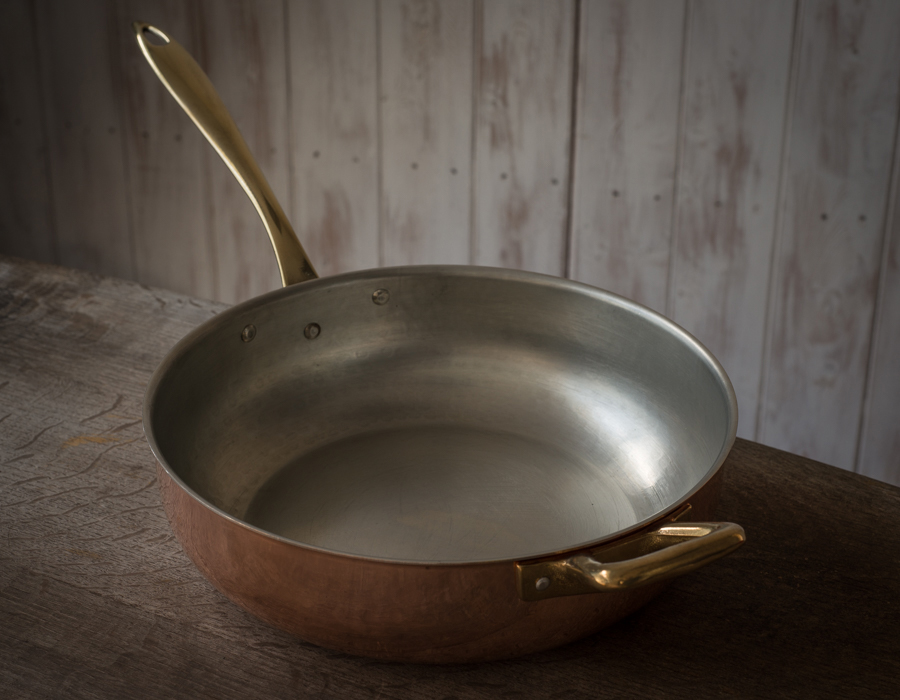
In the Tanucci workshop, this lining is applied by hand using a traditional method known as vergatura. The smith heats the forged copper pan over an open flame until it reaches the melting point of tin. Pure molten tin is then poured into the vessel, and the artisan swiftly wipes the liquid metal across the interior using a pad of natural flax twine.
This manual application creates a smooth, naturally non-reactive barrier that shields your food while maintaining the pan’s exceptional thermal properties. Unlike uniform industrial linings, a hand-tinned interior shows subtle ripples from the artisan’s sweeping movements. This interior lining can be completely renewed by a coppersmith after decades of heavy use, ensuring the structural pan itself never needs to be replaced.
Food Chemistry: The Tin-Copper Synergy
The pairing of hand-wiped tin and dense copper creates a unique environment for food chemistry. Tin is molecularly smooth and naturally crystalline, providing a remarkably uniform surface when heated.
This characteristic gives hand-tinned copper pans a natural, semi-non-stick quality without using any synthetic chemical coatings. When you are folding delicate eggs, sautéing a fragile piece of fresh fish, or preparing starchy risottos, the ingredients glide smoothly across the base.
Furthermore, tin is completely inert to both alkaline and highly acidic foods, meaning it will never alter the flavour profile or colour of a delicate white wine reduction or a slow-simmered tomato sauce. The heat passing through the copper layer meets zero resistance from the thin lining, maintaining the full velocity of temperature adjustments.
Pan Geometries and Culinary Functions
The high heat diffusion rate of copper completely transforms how specific pan shapes interact with food. Because heat moves just as fast up the walls of the vessel as it does across the base, pan geometry becomes a critical factor in your cooking results.
The Flared Sauté Pan (Sauteuse)

A traditional copper sauté pan features low, sloped walls that angle outwards from the base. Because the copper diffuses heat all the way to the top lip of these angled sides, moisture evaporating from your ingredients hits a warm zone that drives steam out of the pan immediately. This prevents steam from pooling over your food, keeping the base dry so you can achieve a crisp pan-sear on vegetables and proteins without stewing them.
The Straight-Sided Rondeau

For slow, uniform braising, a straight-sided copper rondeau uses a different thermodynamic principle. The deep, vertical walls absorb heat from the base and radiate it horizontally inward from every angle simultaneously. This surrounds your ingredients with an even blanket of warmth from all sides, ensuring that a slow-simmering stew or braised meat cooks at the exact same temperature at the top of the liquid as it does at the very bottom.
The Balance of Weight: Material Thickness and Stability
For serious cooking, physical weight provides crucial stability and thermal consistency. An authentic Italian copper pan carries a substantial heft, featuring a wall thickness of two millimetres or more.
This dense volume of metal ensures that the pan stores thermal energy efficiently. When you introduce a cold cut of meat or a large volume of damp vegetables into the base, the pan retains its temperature rather than cooling down suddenly. This consistent heat instantly sears the food, locking in succulence and preserving the natural qualities of your ingredients.

Furthermore, the handle of a traditional Italian copper pan is engineered for balance. Cast in solid brass or bronze, these handles are secured to the copper body using heavy rivets. The cast bronze offers a textured grip that sits firmly in your hand, while the weight of the handle acts as a perfect counterbalance to the heavy base, encouraging steady, deliberate movement around the cooker.
The Practical Science of Copper Maintenance
Caring for hand-forged copper cookware is straightforward when you understand the physical properties of the materials. Because tin is a soft metal and melts at 232°C, simple maintenance rules ensure your cookware remains functional for a lifetime.
- Never Heat an Empty Pan: Always add your cooking fat or liquid to the pan before turning on the burner. If left dry over a hot flame, the interior temperature can quickly exceed the melting point of the tin lining, causing it to blister or run.
- Use Soft Utensils: Avoid using metal spoons, forks, or whisks that can scratch the hand-wiped tin surface. Stick to utensils made of wood, silicone, or heat-resistant resin to keep the protective lining smooth and intact.
- Hand-Wash Only: The harsh chemicals and high heat of a dishwasher will quickly dull copper and degrade the tin lining. Clean your pans using warm water, a soft sponge, and mild dish soap.
- Drying Instantly: To prevent cosmetic water spots from forming on the outer copper walls, dry the pan completely with a soft towel immediately after washing. Avoid using abrasive steel wool on either the inside or outside of the vessel.
The Living Patina: A Changing Finish
A new copper pan leaves the workshop with a bright, mirror-like gleam, but its true character develops once it is introduced to the heat of the kitchen. As copper interacts with oxygen, cooker heat, moisture, and organic acids from ingredients like lemon juice or wine, it naturally oxidises.
Within a few weeks of regular use, the brilliant polished surface transitions into a rich patina, forming a deep tapestry of warm ambers, dark golds, and chestnut browns. This changing surface is not a sign of wear; it is a natural protective layer that shields the metal underneath.
While some owners prefer to use a specialized paste to regularly polish the copper back to its original shine, many choose to leave the patina untouched. This seasoned look serves as a beautiful record of the meals prepared in your kitchen, turning a functional cooking tool into a personal family heirloom.
Integrating Craftsmanship into Modern Kitchens

You do not need a rustic kitchen to style hand-forged copper. The clean lines of contemporary architecture, minimalist marble islands, and raw concrete countertops provide an exceptional backdrop for hammered metal. The contrast between smooth modern surfaces and the textured finish of hand-hammered copper brings a grounded character to a minimalist home.
Because artisanal copper requires a small amount of intentional care, it introduces a slower, more rewarding routine to your kitchen habits. Leaving a single, heavy copper pan on a modern cooktop or hanging a row of pans from an open rack celebrates authentic craftsmanship in your daily environment, offering a timeless tool designed to perform flawlessly for decades to come.